
🧠 Stress & Hormones: The Hidden Tug-of-War Inside Your Body

 By Dr. Shruthi Thennati | Kayakalpa Clinic, Vadodara

“I’m just a little stressed,” we often say — without realizing that stress silently rewires our hormones, metabolism, and mood.
 Whether it’s work pressure, emotional strain, or even constant multitasking, chronic stress has a way of tipping your inner balance off — one hormone at a time.

⚡ What Happens When You’re Stressed

Your body was designed for short bursts of stress — to escape danger or react quickly.
 But modern stress is different. It’s not lions and tigers anymore — it’s deadlines, screens, bills, and sleepless nights.

When stress becomes constant, your adrenal glands (tiny organs above your kidneys) start overproducing cortisol, the “stress hormone.”

Initially, cortisol helps you stay alert.
 But when it stays high for too long, it causes chaos:

  • Raises blood sugar → leading to insulin resistance
  • Increases appetite → especially for sugar and carbs
  • Disrupts sleep and melatonin
  • Imbalances sex hormones (estrogen, progesterone, testosterone)
  • Triggers anxiety and fatigue

This cascade affects everything — your metabolism, menstrual cycle, thyroid, and even your gut health.

💡 The Stress–Hormone Connection

Here’s how stress quietly messes with key systems:
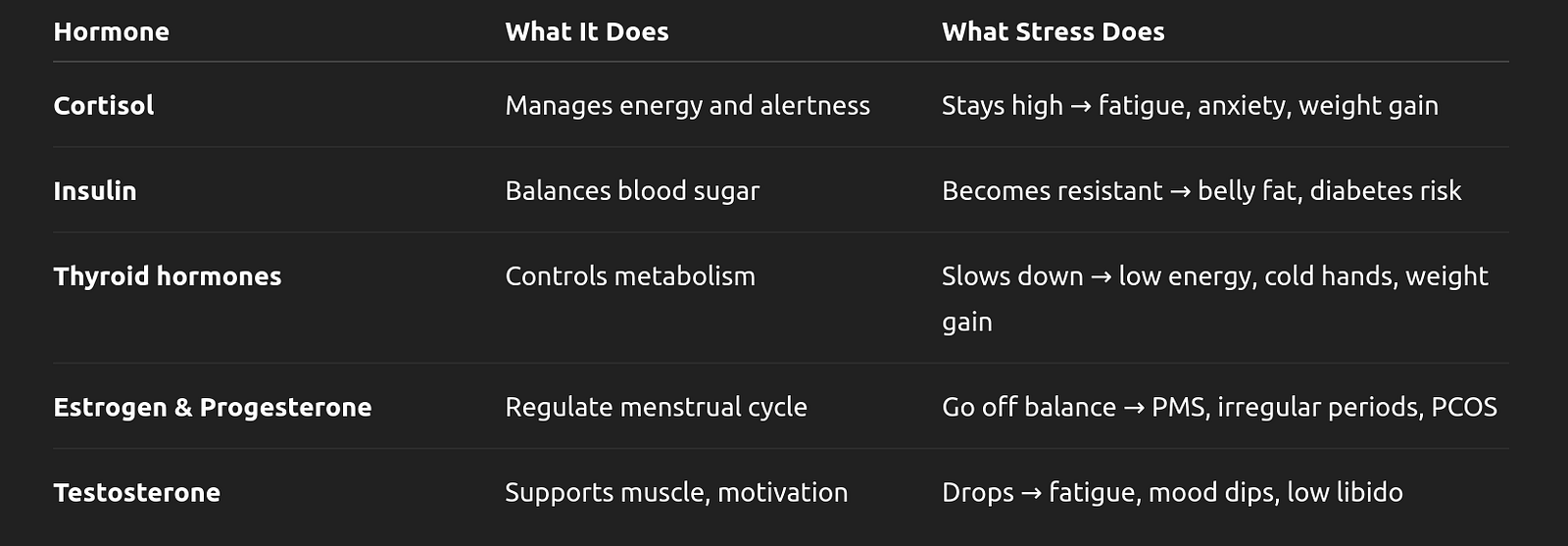
Stress is like a traffic jam in your hormonal highway — everything slows down or gets diverted.

🌿 Rebalancing Your Stress Hormones Naturally

At Kayakalpa Clinic, we believe managing stress isn’t about ignoring it — it’s about building resilience.
 Here’s how to start resetting your body:

Deep breathing or meditation — just 10 minutes daily reduces cortisol.
Regular movement — walking, yoga, or strength training help regulate insulin and mood.
Balanced meals — include protein, fiber, and healthy fats in every meal.
Sleep discipline — aim for 7–8 hours of regular, restorative sleep.
Cut caffeine and screens post 7 PM — let your nervous system unwind.
Seek support — sometimes talking to a physician or counselor helps break the stress loop.

When to See a Doctor

If you’re constantly feeling:

  • Tired even after rest
  • Craving sugar or caffeine
  • Gaining weight around the belly
  • Experiencing mood swings or irregular periods

…it may not be “just stress.” It could be a hormonal imbalance triggered by stress.

At Kayakalpa Clinic, Vadodara, we use a root-cause approach — assessing cortisol, thyroid, insulin, and reproductive hormones — to design a lifestyle plan that helps your body recover balance naturally.

You can’t remove stress from life — but you can retrain your body’s response to it.
 Every deep breath, mindful meal, and good night’s sleep is your way of telling your hormones:
 “You’re safe now. You can relax.”

📍Kayakalpa Clinic, Old Padra Road, Vadodara
🌐 Visit: www.kayakalpa.in
📞 Call/WhatsApp: +91 90232 68462
🔍 Google Maps: Kayakalpa Clinic, Vadodara

Comments

Popular posts from this blog

Telemedicine & AI: New Waves in Healthcare

  By Dr. Shruthi Thennati, Kayakalpa Clinic The healthcare landscape is evolving rapidly, and two key drivers are telemedicine and artificial intelligence (AI) . Together, they are reshaping how patients access care, how doctors diagnose diseases, and how treatments are delivered. Why Telemedicine is a Game-Changer Access from Anywhere  — Patients can consult a doctor without traveling. Reduced Waiting Time  — Virtual consultations speed up treatment decisions. Continuity of Care  — Follow-ups and monitoring are easier, especially for chronic conditions like diabetes and hypertension. AI in Modern Healthcare AI is bringing innovation in: Early Disease Detection  — AI algorithms detect patterns in scans and lab results faster. Predictive Health Analytics  — Identifying potential health risks before symptoms arise. Personalized Treatment Plans  — Data-driven recommendations for diet, medication, and lifestyle. How Kayakalpa Clinic Uses Smart Technology At Kayakalpa Clinic, Vadodara ...

🦠 Gut Microbiota - Your Inner Ecosystem That Shapes Health & Disease

 Dr. Sneha Thennati Did you know you’re not just one organism — but a walking, talking ecosystem? Deep inside your gut lives a massive community of microbes that could be the secret to your health, mood, metabolism, and even disease risk. Welcome to the world of the gut microbiota  — the microscopic allies living in your intestines, now considered one of the most powerful influencers of human health. 🌿 What Is Gut Microbiota? Your gut microbiota is made up of trillions of microorganisms — mostly bacteria, but also fungi, viruses, and other microbes — that live in your gastrointestinal tract. They’ve been with you since birth and evolve constantly with your diet, environment, and lifestyle. While microbes live all over your body, the gut houses the largest and most diverse collection. Together with their genes and metabolites, they form your microbiome  — a key regulator of your overall health. 🧠 Why Is It So Important? Far from being passive passengers, these microbes do a lot o...

Making Healthy Choices Stick - Harnessing the Psychology of Habit Formation

  by Dr. Shruthi Thennati | Kayakalpa Clinic, Vadodara “All our life, so far as it has definite form, is but a mass of habits.” — William James, The Principles of Psychology 🧠 Introduction In our fast-paced lives, daily decisions are often governed by invisible patterns —  habits . Whether it’s reaching for a snack 🍪, scrolling through a phone 📱, or going for a walk 🚶‍♂️, these automatic behaviors deeply influence our health and well-being. Understanding the psychology of habit formation empowers individuals to make consistent, healthy choices and build a sustainable lifestyle 🌱. 🔄 What Is a Habit? A habit is an automatic response to a specific cue, developed through repetition and reinforcement. Psychologist William James defined habits as repeated behaviors shaped by experience, becoming routine over time. Today, we understand this process through the habit loop , popularized by MIT researchers and author Charles Duhigg in The Power of Habit : Cue  — A trigger that ini...